
When the Sensex and Nifty 50 move sharply, the headlines often become a quick indicator of how investors are feeling about the market. A rally may reflect optimism about corporate earnings or economic growth, while a decline can signal concerns over inflation, interest rates or global uncertainty. For new investors, however, an important question remains: what is the difference between these two benchmarks, and why do both matter?
The Sensex and Nifty 50 are India’s two leading equity market indices. Although they track many of the same large companies and frequently move in a similar direction, they differ in their stock selection, exchange association and composition. Understanding how they work can help investors look beyond daily market headlines and develop a clearer picture of the performance of Indian equities.
What Do Stock Market Indices Tell Investors?
A stock market index measures the combined performance of a selected group of shares. It gives investors a convenient way to assess market direction without having to track every listed company individually.
When an index rises, it generally indicates that the weighted value of its constituent stocks has increased. When it falls, the opposite is generally true. However, an index can gain even when several individual stocks decline because larger companies may carry greater weight in its calculation.
Indices also provide a benchmark against which investors can assess their own investments. Someone holding a portfolio of large-cap stocks, for instance, may compare its performance with a suitable market index to understand whether the portfolio has kept pace with the broader market.
An index is not, however, a complete picture of every listed company. Large-cap benchmarks primarily reflect the performance of selected major businesses, while mid-cap, small-cap and broader-market indices can provide additional insights.
Sensex: The Benchmark of the BSE
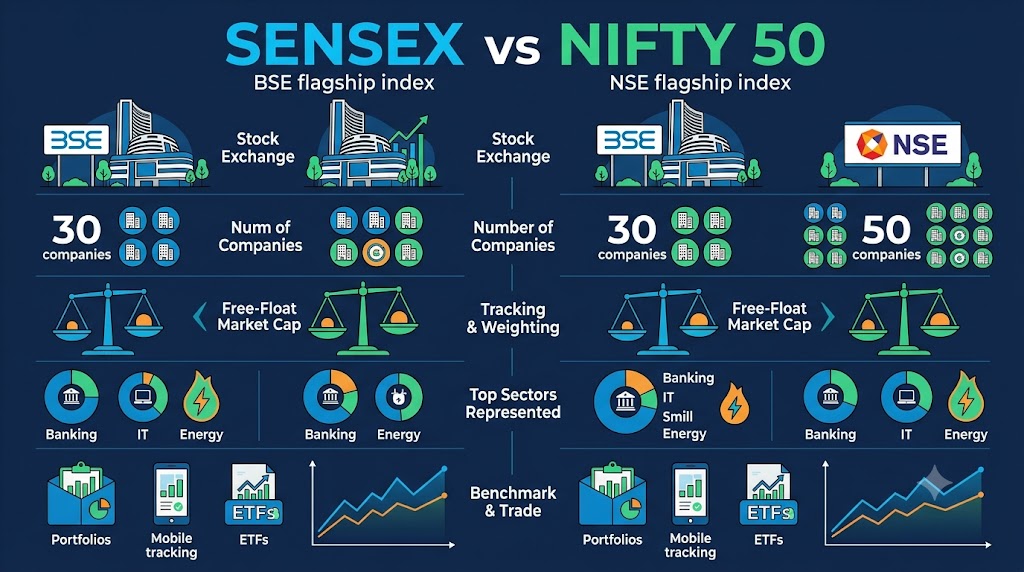
The Sensex, officially known as the S&P BSE Sensex, is the flagship index of the Bombay Stock Exchange (BSE). It tracks 30 major companies selected according to established eligibility and index-maintenance criteria.
These companies represent important areas of the Indian economy, including banking, information technology, energy, automobiles and consumer businesses. Their performance provides an indication of how a selected group of leading companies is faring in changing market conditions.
The Sensex uses a free-float market-capitalisation methodology. In simple terms, the calculation considers the market value of shares available for public trading rather than including all shares held by promoters or other strategic shareholders.
This means that companies with larger eligible market values generally have a greater influence on the index. A significant price movement in a heavily weighted constituent can therefore affect the Sensex more than a similar movement in a smaller constituent.
For investors, the Sensex serves as a widely recognised reference point for tracking large-company performance and understanding the direction of the BSE-listed equity market.
Nifty 50: A Wider Group of Leading Companies
The Nifty 50 is the flagship benchmark of the National Stock Exchange of India (NSE). As its name suggests, it tracks 50 major companies listed on the exchange.
Like the Sensex, the Nifty 50 uses free-float market capitalisation to determine the influence of individual stocks. Its constituents cover multiple sectors, offering a broad view of the performance of leading Indian businesses.
The inclusion of 50 companies gives the Nifty 50 a larger constituent base than the Sensex. However, this does not mean it represents every part of the stock market or that it will always perform better. Its movements depend on the performance and weighting of its constituents, just as the Sensex does.
The Nifty 50 is also widely used to benchmark mutual funds and portfolios, while index funds, exchange-traded funds and derivatives allow market participants to gain exposure to or manage risk associated with the benchmark.
For everyday investors, it is one of the most useful reference points for understanding large-cap market performance in India.
Sensex vs Nifty 50: What Is the Difference?
The distinction between the two indices becomes clearer when their main features are compared.
-
Stock exchange: The Sensex is associated with the BSE, while the Nifty 50 is associated with the NSE.
-
Number of constituents: The Sensex tracks 30 companies, compared with 50 companies in the Nifty 50.
-
Composition: Both include major Indian businesses, and many companies appear in both indices. However, their full constituent lists and stock weightings differ.
-
Calculation: Both use free-float market capitalisation, but each follows its own index rules, base values and maintenance procedures.
-
Market coverage: Both focus on large, prominent companies rather than the entire universe of listed stocks.
-
Investment use: Both serve as benchmarks for evaluating portfolios and underpin investment products linked to their respective indices.
The key point is that the Sensex and Nifty 50 measure broadly similar segments of the market, but they are not identical. Their differences can become more visible when certain sectors or individual heavyweight stocks outperform or underperform the broader market.
Why Do the Two Indices Sometimes Move Differently?
The Sensex and Nifty 50 often rise and fall together because they respond to many of the same economic and financial developments. Yet their daily returns may differ because they contain different stocks in different proportions.
Suppose banking shares experience a strong rally. If banking companies have a greater combined influence on one index than on the other, that index could record a larger gain. The same principle applies when information technology, energy or consumer stocks come under pressure.
Market movements are also influenced by developments beyond individual companies. Changes in crude oil prices, foreign investment flows, currency movements, inflation expectations and interest-rate decisions can all affect investor sentiment.
Corporate earnings remain another important factor. Strong results and improved business outlooks may encourage investors to buy shares, while disappointing earnings or rising operating costs can weigh on prices.
For investors, the useful question is not simply which index has risen more. It is also worth understanding what drove the movement, which sectors contributed to it and whether the gains were spread across companies or concentrated in a handful of heavyweight stocks.
How Investors Can Use the Sensex and Nifty 50
Following these benchmarks can help investors make sense of financial news, but their greatest value comes from using them as reference points rather than trading signals.
To understand market direction: The indices provide a quick indication of how selected large-cap stocks are performing. Looking at sector indices and broader-market indicators alongside them can offer a more complete picture.
To evaluate portfolio returns: Investors can compare their portfolio performance with an appropriate benchmark over the same period. This helps them assess results without assuming that every portfolio should perform exactly like the index.
To assess index funds and ETFs: Investors considering passive investment products should check which index a fund tracks, along with its expenses, tracking error, liquidity and other relevant features.
To build a long-term perspective: Daily market movements can be volatile. Investors should relate their decisions to their financial goals, investment horizon and risk tolerance instead of reacting automatically to every rise or fall.
An index can help measure performance, but it cannot guarantee future returns or remove the risks associated with equity investing.
Common Mistakes to Avoid
One frequent misunderstanding is that a rising Sensex or Nifty 50 means every part of the market is performing well. In reality, large companies can lift an index even when many smaller stocks are declining.
Another mistake is comparing the absolute point levels of the two indices. Their numerical values reflect different base periods and index histories, so a higher point value does not mean one index is more valuable or has performed better.
Investors should also avoid treating a single day's gain or loss as a reliable reason to buy or sell. Short-term movements can reflect temporary changes in sentiment, global developments or reactions to company-specific news.
A more useful approach is to compare percentage returns over the same period, examine the factors driving performance and consider whether the chosen benchmark is appropriate for the investment being evaluated.
Looking Beyond the Daily Market Headlines
The Sensex and Nifty 50 remain central to how India’s stock market is understood and reported. They help investors track leading companies, assess changing market sentiment and compare investment performance against established benchmarks.
For beginners, understanding the distinction between the two can make financial news easier to follow. For experienced investors, examining their composition and sector weightings can provide additional context when interpreting market movements.
Ultimately, neither index should be viewed as a complete representation of the Indian economy or a guarantee of investment success. Both are useful indicators, but sound investment decisions require a broader assessment of business fundamentals, valuation, risk and personal financial goals.
Understanding the Sensex and Nifty 50 is an important first step towards becoming a more informed investor. The real advantage comes from looking beyond the numbers and understanding what is driving them.