
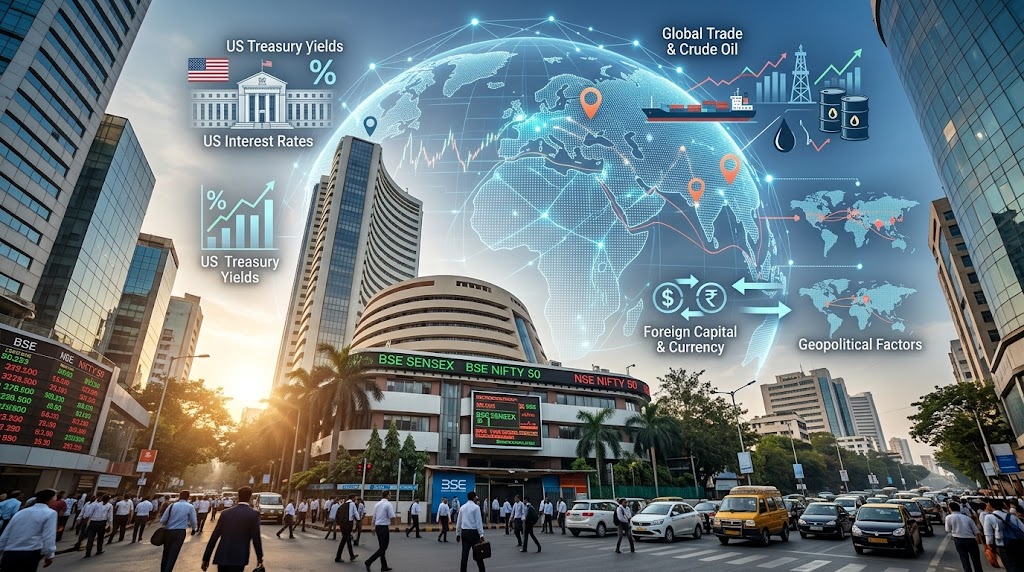
India’s stock market is closely connected to the global economy. Although domestic consumption, corporate earnings and government policies influence market performance, developments in major economies can also trigger sharp movements in Indian equities. Changes in US interest rates, international crude oil prices, currency fluctuations and geopolitical tensions often influence investor confidence, investment flows and business expectations.
For investors, understanding these global connections is essential to interpreting market movements beyond daily price changes. For businesses, the same developments can affect borrowing costs, imported raw materials, export revenues and future investment plans.
Foreign Investor Flows Influence Market Direction
Foreign institutional investors and foreign portfolio investors play an important role in India’s equity markets. When global economic conditions are favourable and investors are willing to take greater risks, overseas capital can flow into emerging markets such as India, supporting share prices.
However, uncertainty can quickly change investor behaviour. If US bond yields rise, global markets become unstable or geopolitical risks increase, foreign investors may reduce their exposure to emerging-market equities and move funds towards assets perceived as safer, including US Treasury securities.
Such withdrawals can put pressure on benchmark indices such as the BSE Sensex and NSE Nifty 50. Large-scale selling may also affect individual stocks, particularly companies with significant foreign institutional ownership.
Domestic institutional investors, including mutual funds and insurance companies, can help absorb some of this selling pressure. However, their buying does not always fully offset foreign outflows, meaning market volatility can persist even when India's domestic economic outlook remains positive.
Crude Oil Prices Affect Inflation and Corporate Earnings
Global crude oil prices are particularly important for India because the country relies heavily on imported petroleum to meet its energy requirements. A sustained rise in oil prices can increase the import bill, put pressure on the rupee and contribute to domestic inflation.
The effects extend across several industries. Airlines face higher aviation fuel expenses, while logistics companies may experience increased transportation costs. Oil marketing companies can come under pressure depending on their ability to pass on costs, while manufacturers and consumer goods companies may face higher expenses for fuel, packaging and other inputs.
Higher energy costs can also reduce household purchasing power by making transportation and essential goods more expensive. If consumers spend more on fuel, they may have less money available for discretionary purchases, affecting sectors such as retail, automobiles and hospitality.
Conversely, a sustained decline in crude oil prices can ease inflationary pressures, reduce costs for energy-intensive businesses and improve India's external trade position. The overall market impact, however, depends on the scale and duration of the price movement and how it affects corporate earnings and economic growth.
US Federal Reserve Decisions Shape Global Liquidity
Monetary policy decisions by the US Federal Reserve are among the most closely watched international developments for Indian investors. When the Fed raises interest rates or signals that borrowing costs may remain elevated, US government bonds can become more attractive relative to equities in emerging markets.
Higher US yields can encourage investors to shift money towards dollar-denominated assets, potentially reducing foreign investment in Indian stocks. Tighter global financial conditions may also increase borrowing costs for businesses and governments.
On the other hand, expectations of interest-rate cuts can improve investor sentiment when they reflect easing inflation and stable economic conditions. However, rate cuts driven by fears of a sharp economic slowdown may have the opposite effect because weaker global demand can hurt corporate earnings.
For India, the implications extend beyond foreign investment. Global monetary policy influences currency movements, financing conditions and the decisions of domestic policymakers, making international interest-rate trends an important factor in market analysis.
Rupee Movements Create Winners and Losers
Currency fluctuations are another important channel through which global developments affect Indian equities. During periods of heightened uncertainty, demand for the US dollar often increases, putting pressure on emerging-market currencies, including the Indian rupee.
A weaker rupee can increase the cost of imported crude oil, electronic components, machinery and other raw materials. Businesses that depend heavily on imports may see their operating expenses rise, particularly when they cannot pass the additional costs on to customers.
However, currency depreciation can benefit some export-oriented companies. Information technology services firms and pharmaceutical exporters that earn a substantial share of their revenue overseas may gain from converting foreign-currency earnings into rupees, although hedging arrangements, imported inputs and other operating costs influence the actual benefit.
Consequently, a falling rupee does not affect every company equally. Investors need to examine a business's export exposure, import dependence, foreign-currency borrowing and pricing power before assessing the impact.
Geopolitical Tensions and Trade Disruptions Increase Uncertainty
Wars, trade disputes, tariffs and disruptions to major shipping routes can create sudden uncertainty across international markets. Such developments may interrupt supply chains, increase freight and insurance costs, delay deliveries and raise the prices of essential commodities.
Indian companies operating in export-oriented industries may face weaker overseas demand or additional trade barriers. Manufacturers that depend on imported components can also experience production delays and higher procurement expenses.
Metals, automobiles, capital goods, chemicals and other globally connected industries are particularly sensitive to changes in international demand and trade conditions. At the same time, companies with diversified supply chains, strong domestic demand or the ability to source materials locally may be better positioned to manage disruptions.
Geopolitical developments can also influence investor sentiment before their actual financial consequences become clear. Markets often react quickly to uncertainty, making short-term price movements more volatile.
Why Different Sectors React Differently
Global economic events do not affect all industries in the same way. Their impact depends on each sector's cost structure, revenue sources, financing requirements and exposure to international markets.
-
Aviation and automobiles: Higher oil prices can raise fuel and transportation costs. Automakers may also face higher prices for imported components, affecting margins and vehicle affordability.
-
Consumer goods and retail: Rising input and logistics costs can squeeze profit margins, while higher inflation may reduce consumers' discretionary spending.
-
Information technology and pharmaceuticals: Export-oriented companies may benefit from a weaker rupee, but their performance also depends on overseas demand, client spending, competition and operating costs.
-
Manufacturing and infrastructure: Higher commodity prices and financing costs can increase project expenses, while strong domestic investment and government infrastructure spending may provide support.
Domestic Strength Can Help Cushion Global Shocks
Despite its exposure to international developments, India has important domestic factors that can support its stock market. Household consumption, infrastructure investment, corporate earnings, government spending and the continued participation of domestic investors all influence market performance.
Domestic institutional investors can provide liquidity during periods of foreign selling, while strong demand within India may help companies maintain revenue even when overseas markets weaken.
However, domestic resilience does not mean Indian equities are insulated from global risks. A prolonged rise in oil prices, persistent foreign capital outflows or a significant slowdown in major economies can still affect inflation, the rupee, corporate profitability and market valuations.
The key is to assess global developments alongside domestic economic indicators rather than treating either set of factors in isolation.
What Investors Should Watch
Investors seeking to understand market movements should monitor several indicators together: US Federal Reserve policy signals, US Treasury yields, crude oil prices, the dollar-rupee exchange rate, foreign investor activity, domestic institutional flows and corporate earnings guidance.
It is equally important to distinguish between short-term market reactions and long-term business fundamentals. A sudden global shock may trigger selling across multiple sectors, but the lasting effect on a company depends on its financial strength, debt levels, cash flow, competitive position and ability to manage costs.
Diversification and disciplined investment decisions can help investors manage uncertainty, although they cannot eliminate market risk. Chasing stocks solely because they appear to benefit from a currency movement or commodity-price change can also be misleading without a closer examination of the underlying business.
Conclusion: Global Awareness Is Essential for Understanding Indian Markets
Global economic events have become an important part of India's stock market story. Interest-rate decisions, oil prices, currency movements, foreign investment flows and geopolitical developments influence how investors value companies and assess the country's economic outlook.
For businesses, these changes can affect input costs, exports, financing and expansion plans. For investors, they provide essential context for understanding movements in the Sensex and Nifty 50.
Ultimately, successful market analysis requires a balanced view of international risks and domestic opportunities. Global events may set the tone for short-term trading, but India's economic fundamentals, corporate performance and long-term growth prospects remain central to the market's direction over time.