
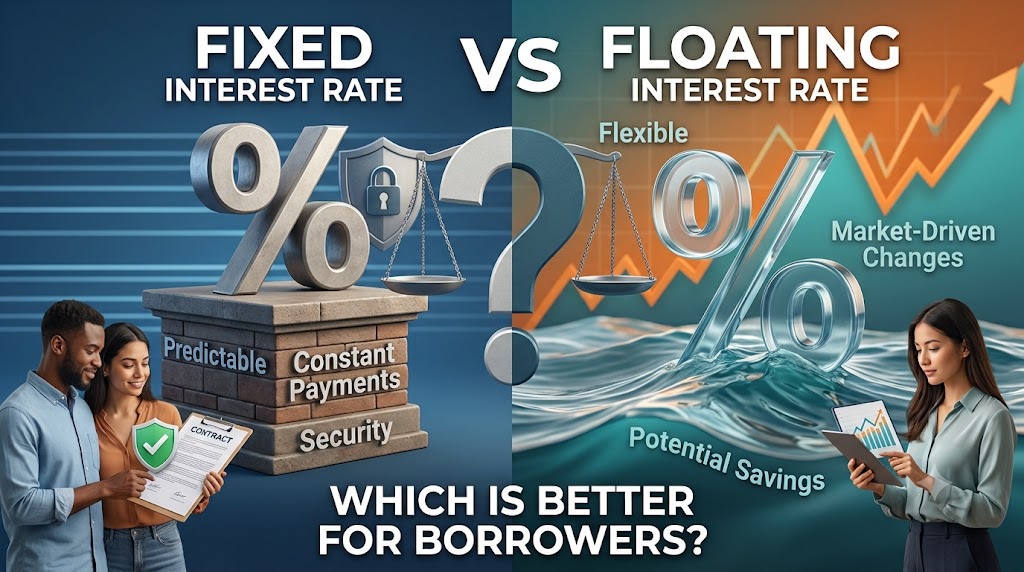
Taking a loan is often a significant financial decision, whether it is to purchase a home, meet a personal expense, fund higher education or expand a business. While borrowers naturally focus on the loan amount and monthly equated instalment (EMI), one crucial decision can influence their financial commitments for years: choosing between a fixed and a floating interest rate.
The difference may appear straightforward, but its impact can extend well beyond the monthly repayment. A fixed interest rate offers greater certainty, making it easier to plan expenses and savings. A floating interest rate, meanwhile, can provide an opportunity to benefit when borrowing costs decline, although it also exposes borrowers to the possibility of higher repayments when rates rise.
For Indian households, salaried professionals and business owners managing multiple financial priorities, the right choice depends on more than market forecasts. Income stability, existing liabilities, repayment capacity and the ability to absorb unexpected expenses all matter.
Understanding how the two options work can help borrowers make a more informed decision, avoid unnecessary financial pressure and choose a loan that supports their long-term goals.
Fixed Interest Rates: The Advantage of Predictable Repayments
A fixed interest rate remains unchanged for the period specified in the loan agreement. This allows borrowers to plan their finances around a more predictable repayment schedule, without worrying about ordinary market-driven interest-rate changes during that period.
For someone managing household expenses alongside rent, school fees, insurance premiums and savings, this certainty can be valuable. Knowing how much must be set aside for the EMI each month makes it easier to organise the family budget and maintain financial discipline.
The same principle applies to business owners. Predictable loan repayments can simplify cash-flow planning, particularly for small businesses that need to allocate money towards inventory, employee salaries, rent and day-to-day operations.
Fixed rates may be particularly attractive when borrowers want protection against rising interest rates. If market borrowing costs increase after a genuinely fixed rate has been agreed, the contractual rate generally remains unchanged for the fixed period.
However, this stability can come at a price. Lenders may offer fixed-rate loans at a higher initial rate than comparable floating-rate products. Borrowers may also be unable to benefit from falling market rates unless their loan agreement permits a change or they refinance on suitable terms.
It is therefore important to establish whether the rate is fixed for the entire tenure or only for an initial period. The term “fixed” should never be interpreted without checking the conditions in the loan agreement.
Floating Interest Rates: An Opportunity to Benefit From Market Changes
Unlike a fixed rate, a floating interest rate can change during the repayment period. The rate generally moves according to a specified benchmark or lending-rate mechanism, subject to the terms of the loan.
In India, many floating-rate loans are linked to external benchmarks, including the Reserve Bank of India's repo rate. However, the effect of a policy-rate change depends on the applicable lending arrangement, the lender's spread and the timing of the reset.
When the applicable borrowing rate falls, borrowers may benefit through a reduction in their EMI, a shorter repayment period or an adjustment to both, depending on the lender's repayment structure. Over time, these changes can help reduce the overall interest burden.
For example, a borrower with a long-term loan may benefit if the applicable interest rate declines and the lower rate takes effect sufficiently early in the repayment schedule.
But floating rates also carry uncertainty. If the applicable rate rises, the borrower could face a higher EMI or a longer repayment period. This can place additional pressure on a household budget or reduce the funds available to a business for expansion and working capital.
Floating-rate loans are therefore not automatically cheaper. Their value depends on how rates change over time, the outstanding loan balance, the remaining tenure and the borrower's ability to manage fluctuations.
Fixed vs Floating Interest Rates: The Key Differences
Monthly EMI: A fixed rate generally offers greater certainty during the agreed fixed period. A floating rate can change the EMI or repayment tenure when the applicable rate is revised.
Initial interest cost: Floating-rate loans may begin with a lower rate than comparable fixed-rate products, but this is not guaranteed. Borrowers should compare actual offers rather than rely on general assumptions.
Protection against rising rates: A genuinely fixed rate protects borrowers from market-driven increases during the fixed period. Floating-rate borrowers remain exposed to changes in the applicable benchmark and lending rate.
Benefits when rates fall: Floating-rate borrowers may benefit from reductions in the applicable rate. Fixed-rate borrowers generally continue paying the agreed rate unless their contract allows a change or they refinance.
Financial planning: Fixed rates can make budgeting easier. Floating rates require greater flexibility and the ability to accommodate changes in repayment obligations.
Prepayment and foreclosure: Charges depend on the loan type, borrower category, agreement and applicable regulations. Eligible floating-rate loans may qualify for regulatory protection against prepayment charges in India, but borrowers should confirm the rules applicable to their specific loan.
The most effective comparison considers the complete cost and conditions of borrowing, not just the interest rate advertised at the time of application.
When Should You Choose a Fixed Interest Rate?
A fixed interest rate may be suitable if financial stability is your priority.
Borrowers with limited flexibility in their monthly budgets may prefer the reassurance of predictable repayments. This is particularly relevant for people with fixed salaries, families managing several financial commitments or individuals who want to avoid the uncertainty of changing interest rates.
A fixed rate may also appeal to borrowers concerned about the possibility of rising borrowing costs. Rather than relying on forecasts about future monetary policy, they can prioritise certainty for the agreed period.
Consider a household planning its finances around a home loan and regular education expenses. A predictable EMI can make it easier to allocate income towards savings, insurance and everyday needs without worrying about a market-driven increase in the loan payment during the fixed period.
However, borrowers should assess whether the fixed-rate premium, if any, is justified by the protection it provides. They should also check the conditions for early repayment and determine whether the loan remains competitive if market rates decline.
When Does a Floating Interest Rate Make More Sense?
Floating rates may suit borrowers who can accommodate changes in their monthly obligations and want the opportunity to benefit from falling borrowing costs.
They can be worth considering for people with adequate emergency savings, relatively flexible cash flows or a repayment strategy that includes periodic prepayments. Business owners with variable income should assess them carefully, since changes in both business revenue and interest rates can affect their ability to repay.
Floating rates can also be attractive to borrowers who do not want to pay a premium for rate certainty. However, the decision should not depend entirely on expectations that the RBI will reduce the repo rate. Policy decisions, inflation trends and broader economic conditions can change, and lending rates may not move in a simple or immediate manner.
A sensible approach is to calculate whether the EMI would remain affordable if the applicable interest rate increased. If a modest rise would disrupt essential expenses or working capital, the borrower may need a more predictable arrangement or a larger financial cushion.
How Interest Rates Affect the Total Cost of a Loan
The interest rate influences how much a borrower pays over the life of a loan, but the final cost also depends on the principal, repayment tenure, fees and timing of rate changes.
Even a relatively small difference in the interest rate can affect the total interest paid on a large, long-term loan. At the same time, a lower EMI does not always mean lower overall borrowing costs. If an increase in interest rates leads to a longer repayment period, the borrower may end up paying interest for more months.
For this reason, borrowers should compare loan offers using the same principal and repayment tenure. They should review the total estimated repayment, applicable fees, rate-reset conditions and the lender's approach to changes in the EMI or tenure.
It is also useful to test different scenarios: What happens if rates remain unchanged? What if they fall? Can the borrower still manage repayments if rates rise?
These calculations provide a more practical basis for choosing a loan than trying to predict the exact direction of interest rates.
A Third Option: Hybrid Interest Rates
Some lenders offer loans that combine fixed and floating rates. These products generally maintain a fixed rate for an initial period before switching to a floating rate under the agreed terms.
A hybrid loan may appeal to borrowers who want repayment certainty in the early years but are willing to accept market-linked changes later. However, the initial fixed period does not guarantee that the loan will remain affordable after conversion.
Before choosing this arrangement, borrowers should check when the rate changes, how the floating rate will be calculated, what happens when the fixed period ends and whether any charges apply. The entire loan structure should be assessed rather than relying solely on an attractive introductory rate.
What Borrowers Should Check Before Signing a Loan Agreement
Before making a final decision, consider these practical steps:
-
Compare the complete cost: Review interest rates, processing fees and other applicable charges across competing offers.
-
Assess your repayment capacity: Ensure the EMI leaves enough room for essential expenses, savings and unexpected financial needs.
-
Understand rate-reset rules: Check the benchmark, lender spread and frequency of revisions for a floating-rate loan.
-
Review prepayment conditions: Understand the rules governing partial payments, foreclosure and any applicable charges.
-
Keep an emergency reserve: Maintain sufficient savings to manage temporary income disruptions or higher repayments.
-
Read the agreement carefully: Confirm whether the rate is fixed throughout the tenure or only for a specified period.
These steps are especially important for first-time borrowers, who may focus on getting loan approval without fully assessing the long-term commitment.
The Bottom Line: Choose Stability or Flexibility Based on Your Needs
There is no single interest-rate option that works best for every borrower. Fixed rates are generally more suitable for those who value predictable repayments and have limited room for financial surprises. Floating rates may appeal to borrowers who can manage uncertainty and want the opportunity to benefit when applicable lending rates decline.
For households, the decision should protect everyday financial security. For entrepreneurs and small businesses, it should support cash-flow management without restricting essential operating expenses or growth plans.
Ultimately, the smartest borrowing decision is not necessarily the one offering the lowest rate today. It is the one that remains affordable across different economic conditions, fits the borrower's financial priorities and keeps long-term obligations manageable.
A loan should help move a financial goal closer to reality—not become a source of avoidable stress. By understanding the trade-offs between fixed and floating interest rates and carefully comparing loan terms, borrowers can make choices that support both their immediate needs and their future financial well-being.